Aluminum extrusion is a manufacturing process that transforms an aluminum billet into a continuous aluminum profile by forcing heated aluminum through a shaped die. The process creates aluminum profiles with specific cross-sectional shapes used in construction, transportation, industrial equipment, electronics, renewable energy systems, and many other applications.
The aluminum extrusion process allows manufacturers to produce lightweight, strong, and corrosion resistant components with complex designs. Compared with traditional machining methods, extrusion provides an efficient way to create long aluminum sections while reducing material waste.
From simple channels and angles to complex custom aluminum extrusion designs, aluminum extrusion technology provides flexible solutions for industries that require precision, durability, and consistent performance.
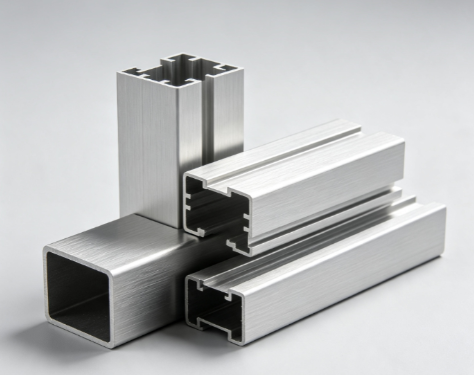
The aluminum extrusion process consists of several manufacturing steps, including billet preparation, heating, extrusion, cooling, cutting, machining, and surface finishing.
The process begins with an aluminum billet, which is a cylindrical piece of aluminum alloy used as the raw material for extrusion.
Different aluminum alloys are selected based on application requirements. Common extrusion alloys include 6061, 6063, and 6082 aluminum alloys because they provide good strength, corrosion resistance, and machinability.
The aluminum billet is heated to a controlled temperature, making the material soft enough to flow through the extrusion equipment while maintaining its mechanical properties.
Before extrusion, the aluminum billet is heated in an industrial furnace.
The heating temperature depends on the aluminum alloy and extrusion requirements. Proper temperature control helps ensure smooth material flow and prevents surface defects during production.
The heated aluminum billet is placed into an extrusion press, where hydraulic pressure pushes the aluminum through a shaped die.
The die determines the final cross-sectional shape of the aluminum profile.
During this step, the aluminum flows through the die opening and forms a continuous extrusion profile with the required dimensions.
A typical aluminum extrusion line may use large equipment with thousands of tons of pressure. For example, some industrial extrusion presses provide 15,000 tons of pressure to manufacture large and complex aluminum profiles.
After leaving the die, the extruded aluminum profile is cooled using air or water cooling systems.
The profile is then straightened to maintain dimensional accuracy and improve surface quality.
The long aluminum extrusion is cut into required lengths using precision cutting equipment.
Depending on customer requirements, manufacturers can provide:
Many aluminum extrusion products require secondary processing after extrusion.
Common machining operations include:
These processes allow aluminum profiles to become ready-to-install components for industrial applications.
For example, a slot aluminum profile used in automation equipment may require drilled mounting holes or tapped threads for assembly.
To improve appearance and performance, aluminum profiles often receive surface treatments.
Common finishing options include:
Powder coating provides:
Anodizing creates a protective oxide layer that improves wear resistance and surface hardness.
Additional surface treatments include polishing, brushing, and chemical finishing.
Aluminum extrusion can produce a wide range of profile shapes based on industrial requirements.
Common types include:
Slot aluminum profiles are widely used in automation systems, machine frames, workstations, and industrial structures.
Their modular slot design allows easy assembly without welding.
A custom aluminum extrusion is designed according to a customer's specific dimensions, mechanical requirements, and application conditions.
Custom profiles are commonly used when standard aluminum shapes cannot meet design requirements.
Applications include:
Standard aluminum profiles include:
These profiles are available in common sizes for general industrial and construction applications.
Aluminum provides a high strength-to-weight ratio, making extrusion profiles suitable for applications where reducing weight is important.
One of the major advantages of aluminum extrusion is its corrosion resistant property.
Aluminum naturally forms a protective oxide layer that helps resist corrosion in many environments.
With additional treatments such as anodizing or powder coating, aluminum profiles can achieve improved durability for outdoor and industrial applications.
The extrusion method allows manufacturers to create complex shapes that would be difficult or expensive to produce through traditional machining.
A shaped die can produce profiles with:
The aluminum extrusion process produces continuous profiles with minimal waste compared with machining a solid block of metal.
This makes extrusion a cost-effective option for high-volume production.
Aluminum extrusion profiles are easy to process after production.
Manufacturers can provide:
This reduces assembly time for customers.
Aluminum extrusion profiles are used across many industries.
Applications include:
Aluminum extrusion helps reduce vehicle weight while maintaining structural strength.
Applications include:
Aluminum profiles are commonly used in photovoltaic mounting systems because of their lightweight design and corrosion resistance.
Applications include:
Slot aluminum profiles are widely used for:
Aluminum extrusion profiles are used for:
The excellent thermal conductivity of aluminum helps improve heat dissipation.
| Feature | Aluminum Extrusion | Aluminum Machining |
|---|---|---|
| Manufacturing method | Material pushed through a die | Material removed by cutting tools |
| Material waste | Low | Higher |
| Production volume | Suitable for large quantities | Suitable for small batches |
| Design flexibility | Excellent for continuous profiles | Excellent for complex 3D parts |
| Cost efficiency | Better for high-volume production | Better for customized low-volume parts |
Many industrial projects combine both methods by producing an aluminum extrusion first and then performing machining operations such as cut, drill, and tap.
Several factors influence the final quality of an extrusion profile.
Different aluminum alloys provide different levels of:
The design and accuracy of the shaped die directly affect profile dimensions, surface quality, and production efficiency.
The capacity of the extrusion press determines what profile sizes and complexity can be produced.
Large industrial presses, including equipment with 15,000 tons of pressure, can manufacture larger aluminum sections.
Proper powder coating, anodizing, or finishing improves the appearance and service life of aluminum profiles.
When selecting an aluminum extrusion supplier, consider the following factors:
Check whether the manufacturer has:
A professional supplier should assist with:
A complete supplier should provide more than extrusion.
Look for capabilities such as:
Quality inspection should include:
Aluminum extrusion is a process where heated aluminum is pushed through a shaped die to create a continuous aluminum profile with a specific cross-sectional design.
An aluminum billet is a semi-finished cylindrical piece of aluminum alloy used as the starting material in the extrusion process.
Aluminum is widely used because it is lightweight, strong, corrosion resistant, recyclable, and easy to shape through extrusion.
The required pressure depends on the profile size, alloy, and equipment. Large extrusion presses can provide thousands of tons of force, with some systems reaching 15,000 tons of pressure for heavy-duty applications.
Yes. Manufacturers can create custom aluminum extrusion profiles using specially designed dies to meet specific dimensions and performance requirements.
Yes. Aluminum extrusion profiles can be cut, drilled, tapped, milled, and CNC machined after extrusion to create finished components.
Slot aluminum profiles are commonly used in industrial automation, machine frames, assembly workstations, and modular structures because they are easy to assemble and modify.
Yes. Aluminum extrusion is naturally corrosion resistant because aluminum forms a protective oxide layer. Additional treatments such as anodizing and powder coating further improve corrosion resistance.
Aluminum extrusion is a versatile manufacturing process that produces lightweight, durable, and customizable aluminum profiles for many industries. By combining aluminum alloy selection, advanced extrusion presses, shaped die technology, precision cutting, machining, and surface finishing, manufacturers can create solutions ranging from standard profiles to complex custom aluminum extrusion components.
Whether used for construction, automation, transportation, renewable energy, or industrial equipment, aluminum extrusion continues to be an efficient manufacturing method for producing high-performance aluminum parts.