The aluminum extrusion process is a manufacturing process that transforms an aluminum billet into a continuous extruded profile with a specific cross-sectional shape. During extrusion, heated aluminum is pushed through extrusion dies to create products with the desired shape, dimensions, and mechanical properties.
The process is widely used because aluminum can be formed into a wide range of extrusion profiles, including simple designs and complex shapes, while maintaining lightweight properties, strength, and corrosion resistance.
Aluminum extrusion is commonly used in industries such as construction, automotive, renewable energy, industrial automation, transportation, and electronics.
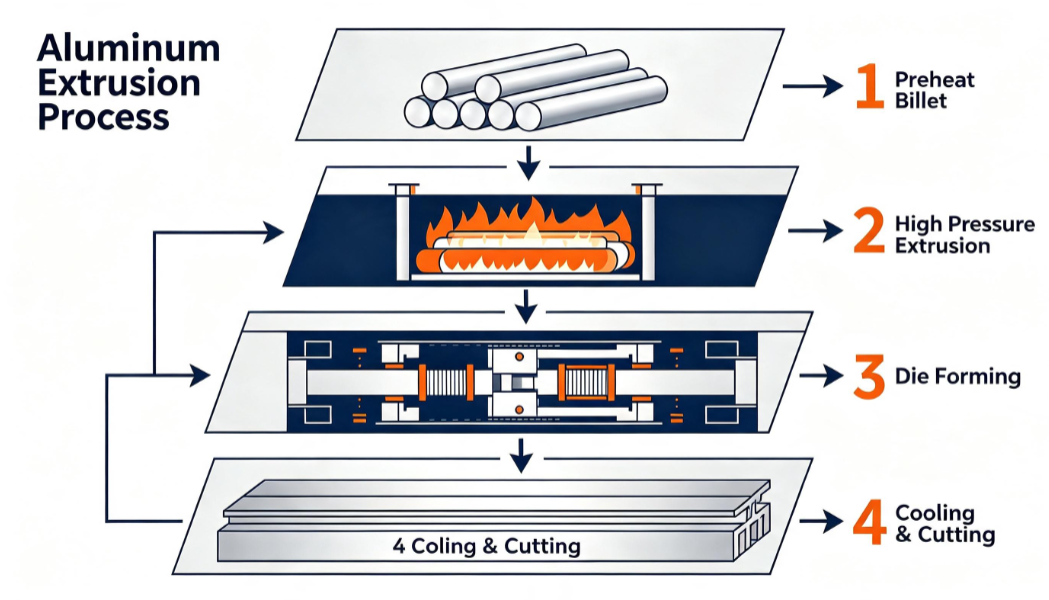
The aluminum extrusion process involves several main steps:
Each step affects the final quality, dimensional accuracy, and performance of the extruded profile.
The process starts with an aluminum billet, which is a cylindrical piece of aluminum alloy used as the raw material for extrusion.
Different aluminum alloys are selected according to the application requirements. Common extrusion alloys include:
The choice of aluminum alloy determines important characteristics, including:
Before extrusion, the aluminum billet is cut into suitable lengths and prepared for heating.
The aluminum billet is heated to a controlled temperature to make the material softer and easier to form.
Heating allows the aluminum to flow smoothly during extrusion while maintaining its mechanical properties.
The temperature depends on:
Proper temperature control helps reduce defects and improves the consistency of the final extrusion profile.
After heating, the aluminum billet is placed into an extrusion press.
The extrusion press applies high pressure to force the softened aluminum through extrusion dies.
The aluminum flows through the die opening and takes the shape of the die design.
When the material exits the die, it becomes an extruded profile with the required cross-sectional design.
The extrusion die determines:
Manufacturers can design extrusion dies to produce:
There are two main types of aluminum extrusion methods:
Direct extrusion is the most common method.
During direct extrusion:
This method is suitable for producing a wide range of standard and custom extrusion profiles.
In indirect extrusion, the die moves toward the stationary aluminum billet.
Advantages of indirect extrusion include:
Indirect extrusion is often used when manufacturers require high precision or improved material flow control.
After the aluminum exits the die, the hot extruded profile is cooled using air or water systems.
Cooling helps stabilize the shape and mechanical properties of the material.
The profile may then go through a stretching process to:
This step ensures the extrusion profile meets customer specifications.
After cooling and stretching, the long aluminum extrusion is cut into required lengths.
Depending on customer requirements, additional processing may include:
Using CNC machines, manufacturers can create finished aluminum components with:
CNC machining allows aluminum extrusion manufacturers to provide ready-to-install parts instead of only supplying standard profiles.
Surface treatment improves the appearance, durability, and corrosion resistance of aluminum extrusion products.
Common surface finish options include:
Anodizing creates a protective oxide layer on the aluminum surface.
Benefits include:
Powder coating provides:
Powder-coated aluminum profiles are commonly used for:
Additional finishes include:
The selected surface finish depends on the application environment and design requirements.
Aluminum is one of the most popular materials for extrusion because it combines several useful properties:
Aluminum provides a high strength-to-weight ratio, making it suitable for applications where weight reduction is important.
Aluminum naturally forms an oxide layer that protects the surface from corrosion.
With additional treatments such as anodizing and powder coating, aluminum extrusion products can achieve improved corrosion resistance for outdoor and industrial environments.
The extrusion process allows manufacturers to create complex shapes that are difficult to produce using traditional manufacturing methods.
A specially designed extrusion die can produce profiles with:
Different aluminum alloys provide different mechanical properties, including:
This allows engineers to select suitable materials for different applications.
Aluminum extrusion profiles are used in many industries because of their flexibility and performance.
Common applications include:
Applications include:
Extrusion profiles are widely used for:
Aluminum extrusion is used for:
High-quality aluminum extrusion requires control throughout the entire manufacturing process.
Manufacturers inspect:
Advanced extrusion equipment and accurate extrusion dies help produce consistent extrusion profiles for demanding applications.
The aluminum extrusion process is a manufacturing method where a heated aluminum billet is pushed through extrusion dies to create a continuous profile with a specific cross-sectional shape.
When aluminum exits the die, it becomes an extruded profile with the shape and dimensions determined by the extrusion die design.
An extrusion die is a specially designed tool with an opening that shapes heated aluminum as it passes through during the extrusion process.
Aluminum extrusion can produce a wide range of shapes, including simple channels, tubes, T-slot profiles, window frames, and complex shapes with internal features.
Common aluminum alloys used for extrusion include 6063, 6061, and other aluminum alloys selected according to required strength, corrosion resistance, and application conditions.
Indirect extrusion is an extrusion method where the die moves toward a stationary aluminum billet. It reduces friction and can improve surface quality and dimensional accuracy.
Yes. Aluminum extrusion profiles can be processed using CNC machines for drilling, cutting, milling, tapping, and creating customized components.
Aluminum naturally forms a protective oxide layer that improves corrosion resistance. Additional surface finishes such as anodizing and powder coating can further enhance durability.
The aluminum extrusion process is an efficient manufacturing method that converts aluminum billet into high-quality extrusion profiles with precise shapes and performance characteristics.
By combining suitable aluminum alloys, advanced extrusion presses, accurate extrusion dies, CNC machining, and professional surface finishing, manufacturers can produce aluminum components for construction, transportation, industrial equipment, and many other applications.
From standard extrusion profiles to complex shapes, aluminum extrusion provides a flexible solution for creating lightweight, durable, and corrosion-resistant products.